
Tag: Fiction

  • Every Picture Tells a Story

    Every Picture Tells a Story

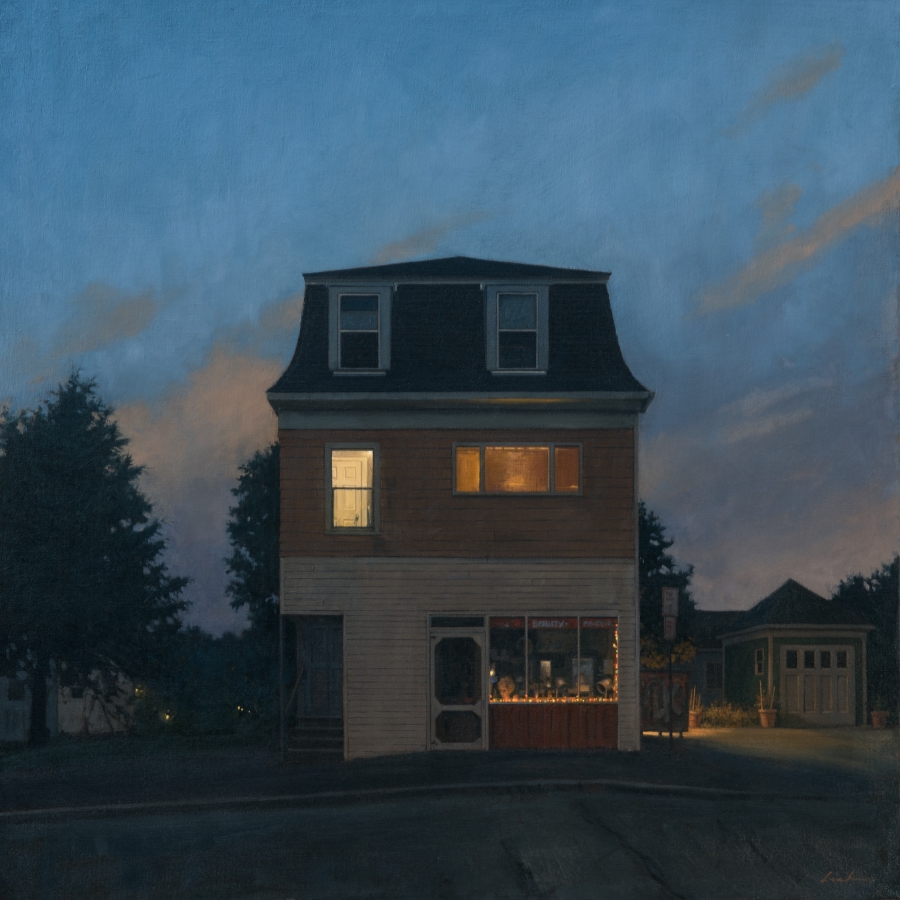
    LF-MANSARD
    Mansard (2016), 36 x 36 in., oil on linen. Courtesy of Linden Frederick

    Linden Frederick paints realistic scenes of mysterious-looking buildings at twilight. About that time of day, Frederick says, “Somebody described it as the point where the dog becomes the wolf.”

    He’s particularly interested in the unglamorous stretches of the country that the economy has left behind. Looking at his paintings, you can imagine the kinds of stories going on inside those lonely houses and empty corner stores.

    A new book, “Night Stories,” pairs paintings by Frederick with short stories inspired by them. The authors include Dennis Lehane, Tess Gerritsen, Anthony Doerr, and Andre Dubus III.

    For Studio 360, I went on a drive with Frederick to find some of the places that have made their way into his paintings. And I got to speak with Richard Russo, Elizabeth Strout, and Lily King about their experience writing fiction based on his paintings. I produced, sound designed, mixed, and composed the score for this piece.
  • Ravening for Delight

    Ravening for Delight

    H. P. Lovecraft’s tales of cosmic horror have long inspired obsessive fandom. His short stories, in the hundred years since they were first published, have extended their tentacular influence to Stephen King, Neil Gaiman, the Alien movies, Dungeons & Dragons, and beyond. Paul La Farge’s new novel, The Night Ocean, traces Lovecraft’s unusual friendship with a 16-year-old fan named Robert Barlow. Lovecraft and Barlow collaborated on a story, also called “The Night Ocean,” that was the last work of fiction either of them wrote before Lovecraft’s death and Barlow’s own tragic end.

    I interviewed La Farge by phone and produced a piece for The Organist. I also sound designed and mixed the rest of the episode.

  • Hilary Mantel Reimagines History

    Hilary Mantel Reimagines History

    The novelist Hilary Mantel has definitively updated our idea of Henry VIII—and our notion of what historical fiction can be. In her stylistically daring and formally inventive novels “Wolf Hall” and “Bring Up the Bodies,” she focuses on a less well-known figure who’s always been depicted as kind of a weasel: Thomas Cromwell. He was the son of a blacksmith who maneuvered his way to become Henry’s right-hand man. The novels have been huge bestsellers, and they both won the Man Booker Prize. The books have been adapted into a Masterpiece Theater miniseries on PBS and a two-part, five-and-a-half hour show that ran on Broadway, both called “Wolf Hall.”

    I produced this interview with Mantel for Studio 360.