
You’ve heard of a band playing a house party, but what if the band played the house itself? A new music venue in New Orleans called Music Box Village is investigating the acoustic possibilities of architecture. Rob Walker reported this story and I edited and produced it for The Organist (KCRW).
Author: Matt
-

Acts of Kindness Help Family Overcome Travel Ban
For Here & Now (NPR + WBUR) and Kind World, I reported this story about an Iraqi family split up by President Trump’s executive order in January limiting travel from seven countries. Labed Al-Hanfy, the father, had been an interpreter for the U.S. military in Iraq. He wanted to move his family to America to escape militants who were killing collaborators in his neighborhood. But his eldest daughter, Banah, got stuck behind when her visa was delayed. Then, the executive order dropped, and it looked like Banah would be forced to hide in Baghdad indefinitely. Until a group of Mainers heard about the family’s plight and decided to try to help. You can hear the story on iTunes or at WBUR.
-

How the Rorschach Got Its Blots
For The Organist (KCRW & McSweeney’s), I produced this story on the surprising backstory of the Rorschach test, that all-purpose metaphor we use for “means whatever you want it to mean.” As Damion Searls, the author of a new biography of Hermann Rorschach explains, that’s not what the test is really about at all. Check out the story in iTunes or at KCRW.
-

As You Dislike It
Sometimes you don’t like what everyone expects you to. When you’re a critic, that can look contrarian or intentionally provocative. Longtime Pittsburgh theatre critic Ted Hoover is neither of those things, but he does throw some very entertaining shade on Shakespeare in this feature I produced for Studio 360.
-

Way to Go, Einstein
On the 100th anniversary of the publication of the theory of relativity, I produced an episode of Studio 360 (PRI + WNYC) looking at how Einstein upended the way we see space and time, his effect on pop culture, and how one of his most preposterous ideas was ultimately proven right.
For this hour, I came up with the idea, wrote the treatment, booked and prepped the interviews, and wrote the script. For the 18-minute narrative feature that opens the show, I produced the interviews, wrote the script, edited the audio, provided scoring and sound design.
-

Is Laughter Good for Your Health?
For this episode of Studio 360, Kurt Andersen and Only Human host Mary Harris go to a session of laughter yoga to find out about the health effects of laughter. We trace the origin of laughter with researcher Robert Provine, and look at laughter’s effect on the brain with neuroscientist Sophie Scott. Chris Gethard talks about the positive effect that comedy has had on his struggles with depression, and doctors talk about when it’s OK to laugh with patients (and when it’s not).
I came up with the concept, wrote the treatment, booked and prepped the interviews, and provided sound design and scoring for this hour.
-

Hilary Mantel Reimagines History
The novelist Hilary Mantel has definitively updated our idea of Henry VIII—and our notion of what historical fiction can be. In her stylistically daring and formally inventive novels “Wolf Hall” and “Bring Up the Bodies,” she focuses on a less well-known figure who’s always been depicted as kind of a weasel: Thomas Cromwell. He was the son of a blacksmith who maneuvered his way to become Henry’s right-hand man. The novels have been huge bestsellers, and they both won the Man Booker Prize. The books have been adapted into a Masterpiece Theater miniseries on PBS and a two-part, five-and-a-half hour show that ran on Broadway, both called “Wolf Hall.”
I produced this interview with Mantel for Studio 360.
-

Claudia Rankine on the Experience of Racism
Claudia Rankine’s 2014 book of poetry Citizen: An American Lyric became the first book ever nominated in two categories by the National Book Critics Circle Awards — poetry and criticism. That reflects the book’s varied literary approaches as well as its timely, acute critique of racism in contemporary American culture.
I produced this interview for Studio 360.
-

Basia Bulat’s Pop Transformation
Break-ups pretty much always suck. But when you’re a songwriter, at least you might be able to get some material out of it.
Not so long ago, the Canadian songwriter and singer Basia Bulat suffered her own difficult split. She pulled herself together, wrote a set of acoustic breakup songs, and drove south from Toronto to Louisville, Kentucky. There, she went into the studio with My Morning Jacket frontman Jim James to record her fourth album. The results were very different from what she expected.
I produced this interview + performance chat for Studio 360.
-

The Music Collector
When a friend showed Nathan Salsburg some old records he had come across while clearing out an abandoned house, Salsburg at first wasn’t interested. He’s the curator for the Alan Lomax Archive, so he knows most old records are junk. But when he saw a rare 78-rpm Mississippi John Hurt, he knew his friend was onto something. That discovery led to a late-night Dumpster-dive and days spent rescuing fragile 78s from the collection of an enigmatic hoarder. I produced this story for The Organist, the podcast from KCRW and The Believer.
-
Man in Space
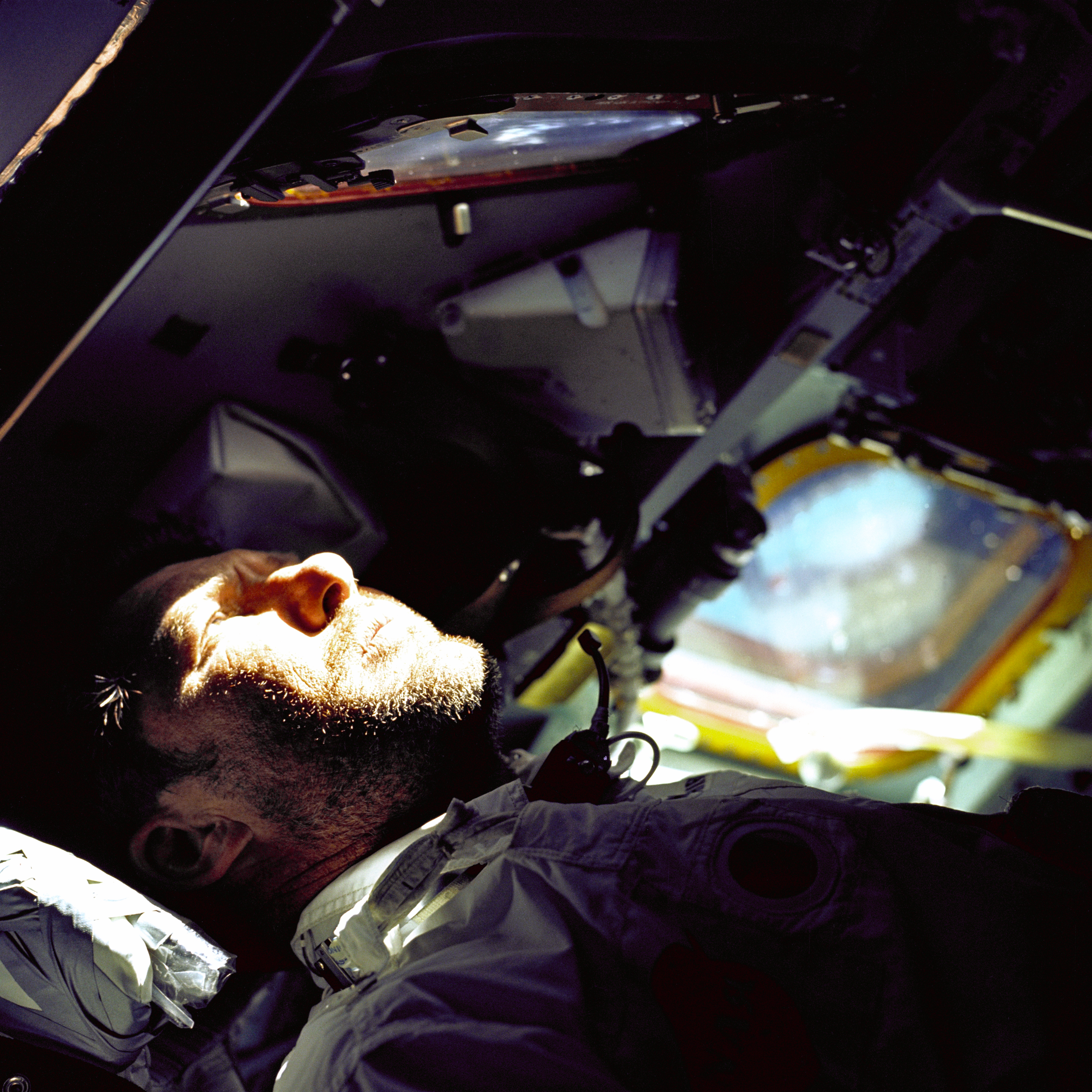
A photo of a man sitting in the dark, in profile, looking out a window. His face is illuminated by a glaring light. Long dark whiskers — not quite a beard — bristle out across his cheek and chin. He isn’t a fugitive holed up in a motel room, watching the parking lot, but an astronaut: you can tell by the way the picture is oriented, so the window is at the top of the frame. He’s wearing a white jacket with zippers and pockets in unconventional places. What looks like a call-center hands-free microphone hangs around his neck.
In the background, there’s another window at a different angle (we’re in the command module, so the walls are curved and canted inward), and you can see that the glass is very thick, with bright yellow gaskets surrounding it.
One of the first things you notice about this picture is its extraordinary image quality. Even at high magnification, the details are sharp, with very little graininess. The exposure would have been tricky with such stark contrast between the dark shadow and bright light, but the photographer has captured a broad range of tones while only slightly overexposing the astronaut’s face. The colors have the hallucinogenic quality of Kodachrome. The shadows that take up most of the image are rendered in melancholy violets.
Maybe the next thing you notice about this picture is the expression on Walter Schirra’s face, of grim concern shading into fatalism. It’s the look of a father driving out of town at dawn, refusing to give false comfort to the kid in the passenger seat. We’re looking up at his face from slightly below, reinforcing the paternal impression. He’s a man with a lot on his mind.
One thing you might notice about Schirra’s expression is that it lacks completely the kind of hokey jollity or ennobled optimism that astronauts usually feel obliged to twist their faces around. Nearly all astronaut portraits reflect one or the other pole of this emotional propaganda campaign — the astronaut, despite the gravity of her mission, enjoys goofing off; the astronaut, with her god’s-eye-view of Earth, feels renewed hopefulness that mankind will overcome its violent parochialism and give peaceable coexistence a chance.
This picture is different. This is the astronaut as gnarled mariner, Odysseus or Ahab, damaged and determined and obsessed and merciless. He looks like he might have half a bottle of bourbon under the seat. He doesn’t look like someone who sleeps much.
Apollo 7 was Schirra’s third and final space flight; he was the only astronaut to fly in the Mercury, Gemini, and Apollo programs. While orbiting Earth on his last mission, Schirra developed a bad cold and became deeply irritable, snapping at his crew and at ground controllers. The mood of the three men in the command module grew strained. The virus spread. This photo was taken on day nine of the ten-day mission.
Apollo 7 was the first manned space mission after Gus Grissom, Ed White, and Roger Chaffee burned to death inside their command module during the Apollo 1 launch test on January 27, 1967. An unusually high cabin pressure and 100 percent oxygen mixture made everything in the capsule, from Velcro to aluminum, highly flammable. The astronauts had complained about the module’s fire hazards and its inward-swinging hatch, impossible to open against positive pressure. Schirra had been on a backup crew on January 27. After an earlier test he reportedly said, “There’s nothing wrong with this ship that I can point to, but it just makes me uncomfortable.”
It took five minutes for rescuers to get the hatch open on the day of the fire. “The personnel who had been involved in removing the hatches attempted to locate the crew without success,” reads NASA’s report on the accident. Once the smoke cleared, firefighters found the crew, their spacesuits and oxygen hoses so melted that it took 90 minutes to remove their bodies from the capsule.
(Originally posted on Medium)
-
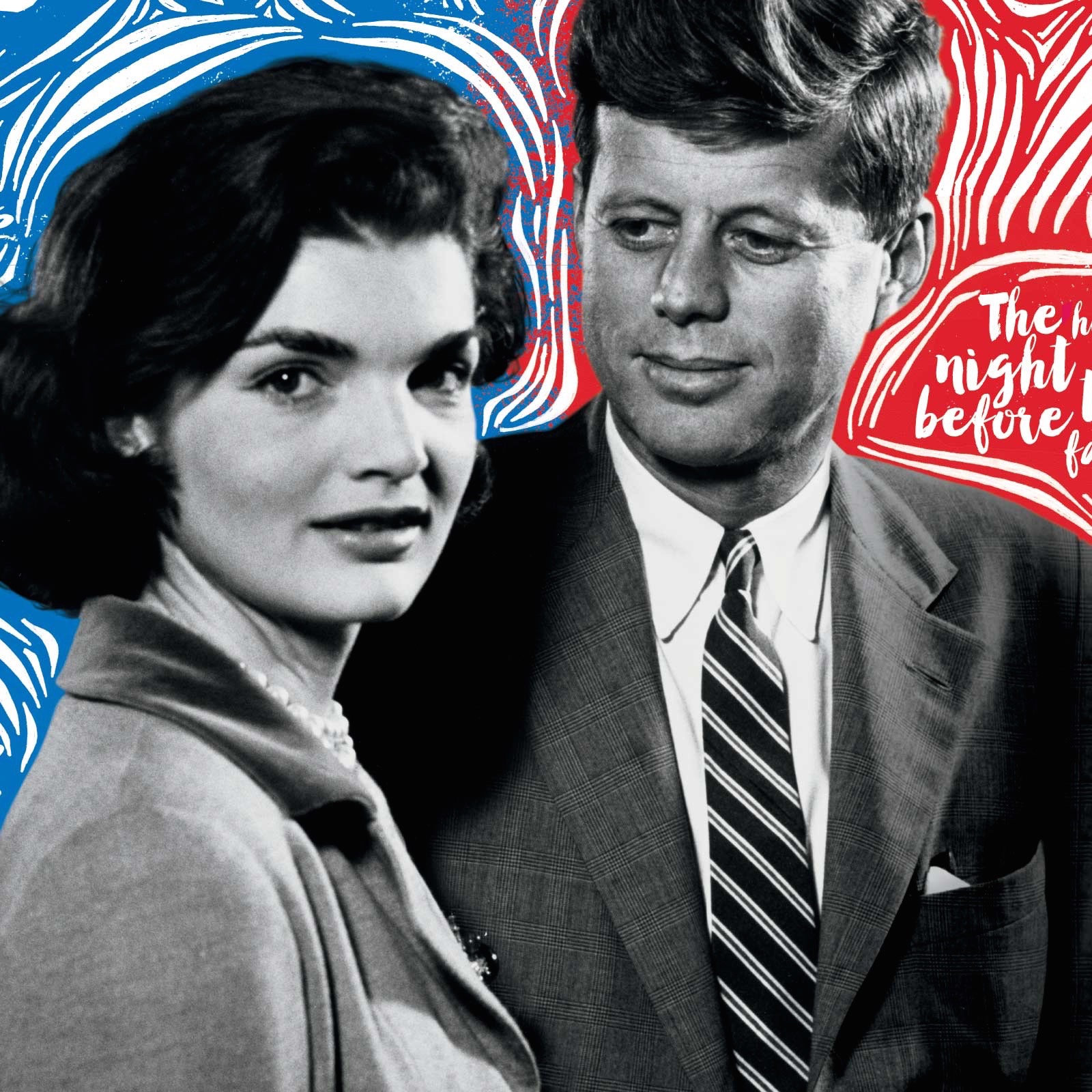
JFK Sings on the Moon
Recently, the Fort Worth Opera decided to commission a new opera to tell the story of JFK’s final night—a night he spent with the first lady in a Fort Worth hotel room. They turned to two up-and-coming stars of contemporary opera, the composer David T. Little and librettist Royce Vavrek. I interviewed Little and Vavrek and produced this feature for Studio 360 explaining how they wrote an opera about one of the most famous political figures of the 20th century.